Medicinal AI
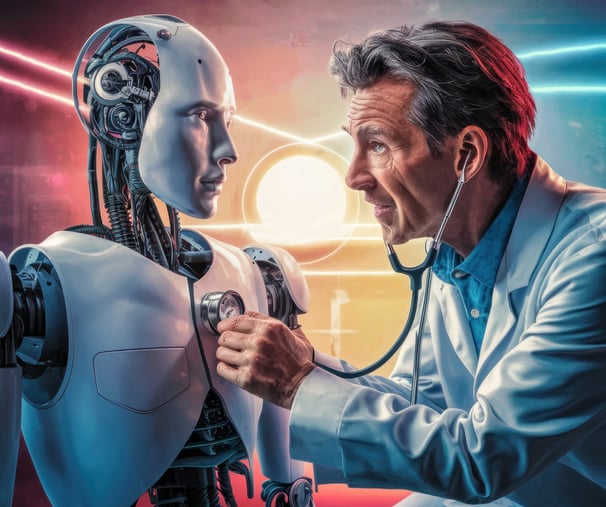
In the Healthcare Industry, AI is Revolutionizing Patient Care and Medical Research.
The integration of artificial intelligence in healthcare is reshaping patient care, medical diagnostics, and research methodologies. This marks a pivotal shift in the industry. Ai is not just enhancing efficiency but also improving outcomes, paving the way for personalized medicine and accelerating innovation.
At the forefront, AI-powered diagnostic tools are transforming patient assessments. These systems, utilizing deep learning algorithms, can analyze medical imaging, such as X-rays and MRIs, with incredible accuracy. They consistently outperform human experts in speed and precision. The real-world impact even extends beyond diagnostics to patient monitoring. Here the AI algorithms process real-time data, flagging potential health issues before they become critical. This enables healthcare providers with the tools to proactively manage chronic conditions.
Personalized treatment plans are another frontier where AI is making significant strides. By analyzing vast amounts of data, including genetics, AI models can identify optimal treatments that are tailored to individual patients. This approach enhances the effectiveness of care and minimizes adverse reactions.
AI's role in medical research is equally transformative. Expedited drug discovery processes are set to revolutionize medicine. Personalized treatment will open the door to treating illnesses thought to be untreatable and potentially curing some diseases thought to be incurable. It is able to do this through the analysis of complex biochemical interactions. Machine learning models can predict the efficacy of drug compounds, reducing the time and cost associated with traditional trial-and-error methods. Furthermore, AI is instrumental in analyzing epidemiological data, aiding in the detection of disease patterns, and contributing to public health strategies.
Despite these advancements, the integration of AI in healthcare is not without challenges. Data privacy and security concerns are paramount, given the sensitive nature of medical information. Additionally, the ethical implications of AI-driven decisions in clinical settings necessitate rigorous scrutiny to ensure fairness and accountability.
The potential of AI in healthcare is vast, offering opportunities to enhance patient care, streamline operations, and foster innovative research. As the sector continues to evolve, the symbiosis of technology and healthcare promises to unlock new horizons in medical science, fundamentally altering the landscape of patient treatment and medical research.
In the realm of clinical decision-making, AI is proving to be a game-changer. Advanced algorithms analyze patient data and medical histories, assisting healthcare professionals in diagnosing and formulating treatment plans with enhanced precision. This not only streamlines the diagnostic process but also significantly reduces the margin for error, ensuring patients receive the most effective care tailored to their unique health profiles.
The advent of AI in healthcare extends beyond individual patient interactions, influencing public health strategies. Through the analysis of vast datasets, AI applications can identify trends and outbreaks of infectious diseases, enabling quicker and more effective responses to public health emergencies. This capability is critical in preventing the spread of diseases and managing public health resources efficiently.
Moreover, AI-driven technologies are revolutionizing the field of medical training and education. Virtual reality simulations, powered by AI, provide medical professionals with immersive training experiences, allowing them to practice complex procedures and improve their skills without risking patient safety. These educational tools are invaluable in preparing the next generation of healthcare providers, ensuring they are well-equipped to meet the challenges of modern medicine.
In conclusion, AI's integration into healthcare is transformative, offering profound benefits in patient care, public health management, and medical education. As technology advances, the potential for AI to further enhance healthcare delivery and outcomes is immense, promising a future where healthcare is more accessible, effective, and personalized.
As AI continues to evolve in healthcare, ethical considerations and data governance emerge as critical focal points. The deployment of AI systems must be guided by stringent ethical standards to ensure patient autonomy, privacy, and equity in care delivery. Robust data governance frameworks are essential to safeguard sensitive patient information against breaches and misuse, maintaining trust in AI-driven healthcare systems.
Future directions in AI for healthcare point towards more integrated, intelligent systems capable of not only diagnosing and treating diseases but also predicting health risks and preventing illnesses before they occur. Collaborative efforts among technologists, healthcare professionals, and policymakers are crucial to realize the full potential of AI in healthcare, ensuring it serves as a tool for enhancing health outcomes and promoting well-being globally.
This final section emphasizes the importance of addressing the ethical and data governance challenges associated with AI in healthcare and outlines the promising future of AI-driven preventive and predictive healthcare solutions.